The Mid-Century Ranch Problem: Why Omaha Homes Leak Heat
Drive through any established neighborhood in Omaha, and you'll spot them: charming mid-century ranch homes with their characteristic low-slung rooflines and open floor plans. These houses have real character, but they often come with a hidden liability. Many were built in the 1950s and 1960s, when insulation standards were dramatically different from today's energy codes. Back then, builders typically used minimal insulation, and much of it has settled, deteriorated, or simply never provided adequate coverage in the first place.
The attic is where the real problem lives. A poorly insulated attic in Omaha can account for 25 to 40 percent of a home's total heat loss during winter and heat gain during summer. That means your furnace and air conditioner are working overtime to maintain comfort, while your utility bills climb steadily higher. Homeowners often notice the problem first in their heating and cooling costs, then later when they climb into the attic and discover thin batts of fiberglass or loose-fill insulation that's done little to stop air leakage. The culprit isn't just inadequate R-value; it's the air movement itself. Traditional insulation materials don't seal air leaks, and air leakage is responsible for the majority of thermal loss in older homes.
Spray Foam vs Blown-In Insulation: The Key Differences
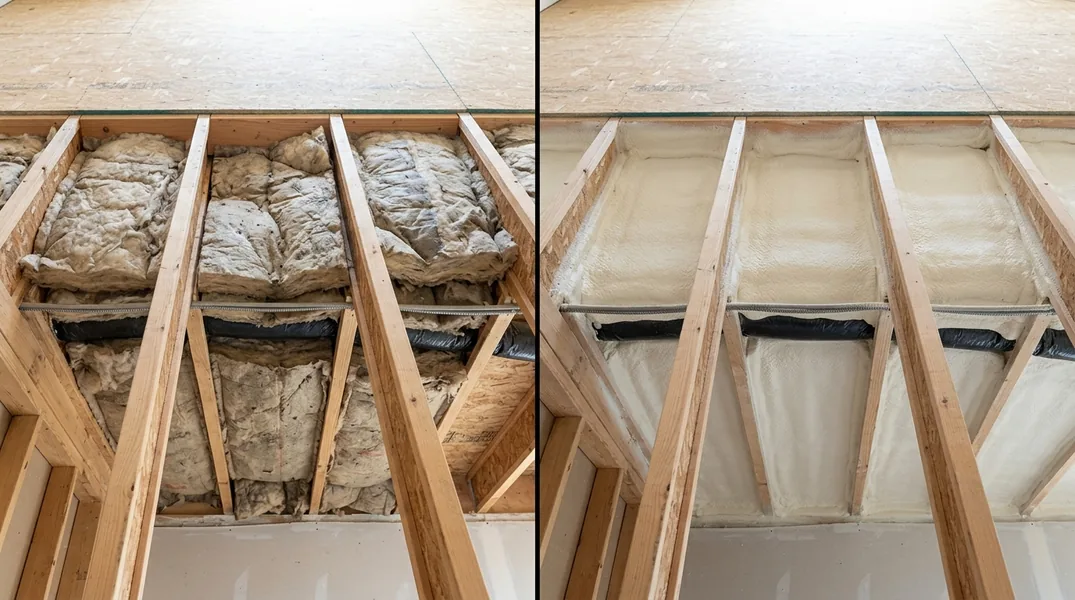
When homeowners start researching solutions, the comparison between spray foam vs blown in insulation quickly becomes the central question. Both materials have their place, but they work in fundamentally different ways. Blown-in insulation, whether cellulose, fiberglass, or mineral wool, relies on bulk material to slow heat transfer. It's installed by blowing loose fibers into cavities, and it does improve insulation value. However, blown-in insulation does not seal air leaks. Air can flow around and through the material, undermining its effectiveness.
Attic Spray Foam Insulation works differently. When applied, it expands and hardens in place, creating a continuous thermal and air barrier. This dual action is critical: spray foam not only provides insulation value, but it also seals every crack, crevice, and penetration. In a mid-century ranch attic with countless air leaks around ductwork, electrical boxes, and roof penetrations, this sealing capability makes a measurable difference in comfort and energy efficiency. The result is that homeowners often see more dramatic improvements in their utility bills with spray foam than with blown-in alternatives, even though the upfront pricing may be higher.
Spray Foam vs Fiberglass: Why Fiberglass Falls Short in Older Attics
Fiberglass batts have been the standard attic insulation for decades, and they remain popular because they're affordable and widely available. However, the comparison between spray foam vs fiberglass reveals why fiberglass is increasingly inadequate for older homes. Fiberglass batts are installed between joists and rafters, which means they only address the space between framing members. Large air gaps exist around the batts, around penetrations, and at the perimeter where the attic meets the exterior walls. These gaps create thermal bridges that allow unconditioned air to move freely through the attic space.
Additionally, fiberglass batts can settle over time, especially in attics that experience temperature fluctuations like those in Omaha. As the material compresses, its R-value decreases. Fiberglass also absorbs moisture, which further degrades its performance and can create conditions for mold growth. Closed Cell Spray Foam Insulation eliminates these problems. It doesn't settle, it resists moisture absorption, and it seals the entire attic space, not just the cavities between framing. For homeowners comparing the long-term value and performance, spray foam consistently outperforms fiberglass in older homes where air sealing is critical.
Spray Foam vs Cellulose: Durability and Performance Over Time
Cellulose insulation is another option homeowners encounter when researching the best insulation for attic spaces. Made from recycled paper, cellulose is environmentally friendly and has a decent R-value per inch. The comparison between spray foam vs cellulose hinges on durability, moisture resistance, and long-term performance. Cellulose is treated with fire retardants and can be a good choice in some applications, but it shares a critical weakness with fiberglass: it doesn't seal air leaks. Like blown-in fiberglass, cellulose settles over time, and it is highly susceptible to moisture absorption. In a humid climate or in an attic with any roof leaks, cellulose can absorb water, lose R-value, and develop mold. It also attracts rodents and insects more readily than spray foam.
Spray foam, by contrast, is inert and inhospitable to pests and mold. It doesn't absorb moisture (especially closed-cell varieties), and it maintains its R-value for the life of the home. While cellulose may cost less initially, the superior durability and performance of spray foam typically justify the investment over a 20 to 30-year timeframe. For homeowners planning to stay in their mid-century ranch for the long term, spray foam is the best insulation for attic applications where durability and air sealing both matter.
The Best Insulation for Attic: Why Spray Foam Wins for Omaha Homes
After comparing spray foam to blown-in insulation, fiberglass, and cellulose, the case for spray foam becomes clear for older homes in Omaha. The best insulation for attic spaces is one that combines high R-value with complete air sealing, resists moisture and pests, and maintains its performance for decades. Spray foam checks every box. Whether you choose Open Cell Spray Foam Insulation or Closed Cell Spray Foam Insulation depends on your specific needs and budget, but both outperform traditional alternatives in older attics.
Open-cell spray foam is lighter, more affordable, and allows some moisture vapor to pass through, making it suitable for many attic applications where vapor permeability is desired. Closed-cell spray foam is denser, provides a higher R-value per inch, and offers superior moisture resistance, making it ideal for attics in humid climates or homes with any history of moisture issues. Both create an air-tight seal that stops drafts and reduces the workload on your HVAC system. The result is lower utility bills, more consistent interior temperatures, and a more comfortable home year-round.
Attic Spray Foam Insulation Near Me: Getting Professional Help in Omaha
If you own a mid-century ranch in Omaha and recognize the signs of poor attic insulation (high heating and cooling bills, cold spots in winter, hot rooms in summer, or visible gaps and settled insulation), the next step is to talk with a professional. Spray foam installation is not a DIY project. It requires specialized equipment, training, and safety precautions. A qualified contractor will assess your attic, identify air leaks, evaluate existing insulation, and recommend the right spray foam solution for your home's specific needs.
Omaha Spray Foam Insulation serves homeowners throughout the area, including Bellevue, Papillion, and La Vista. We understand the unique challenges of older homes and the climate demands of the Omaha region. If you're ready to stop losing money to heat loss and improve your home's comfort, contact us for a free estimate. You can also reach us by phone at (402) 807-2989 to discuss your project and learn more about how Attic Spray Foam Insulation can transform your home's energy efficiency.
Looking for a professional spray foam insulation contractor in Omaha? Omaha Spray Foam Insulation responds fast for all your spray foam insulation needs.
Get a Free Quote