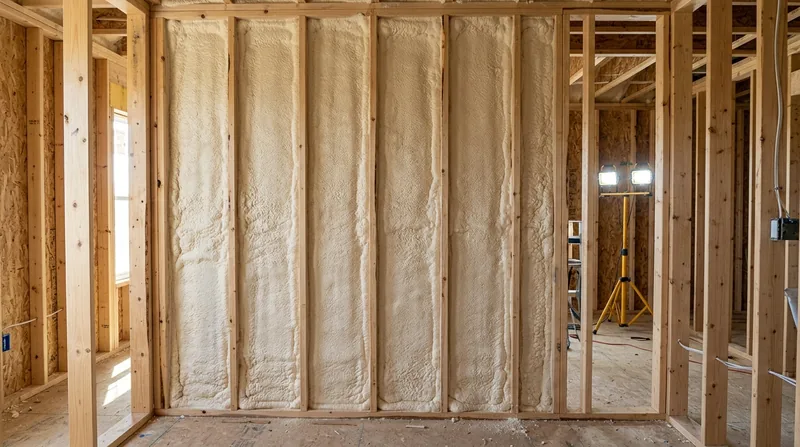




Open Cell Spray Foam Insulation in Omaha fills interior cavities, attic framing, and vaulted ceilings across Zone 5A with a lightweight, air-sealing foam that works best where sound dampening and vapor permeability matter more than maximum R-value per inch. Omaha's older housing stock, from early 1900s bungalows in Dundee and Benson to mid-century ranches and newer two-story homes pushing toward Elkhorn and Papillion, often has vaulted master bedrooms, bonus rooms over garages, and interior partition walls where open cell delivers both thermal control and acoustic benefit. Our winters are cold and windy off the Missouri River, our summers hot and humid, and that seasonal swing means vapor drive reverses twice a year, pushing inward during summer moisture and outward during dry winter cold. Open cell foam's breathable nature handles that reversal without trapping moisture in the cavity, making it the right choice for interior applications where a closed-cell vapor barrier would create condensation risk. We've been handling spray foam insulation and air sealing across Greater Omaha since 2009, and we can help you understand whether open cell, closed cell, or blown-in insulation is the right fit for your home's actual use and climate position.
Why Open Cell Spray Foam Matters in Omaha's Climate and Older Housing Stock
Omaha's residential mix creates two distinct insulation problems. Homes built before 1970 sit over full basements with balloon-framed walls and rim joists that leak cold air, while newer homes in Millard, Elkhorn, and Papillion often have vaulted ceilings, bonus rooms, and cathedral framing where standard fiberglass batts leave gaps and air leaks. Open cell foam solves both by filling irregular cavities completely, sealing every edge and penetration in a single pass. The foam expands to roughly 3.5 pounds per cubic foot, stays soft enough to cut and trim, and breathes, meaning moisture can move through it rather than pooling at the cavity boundary the way closed-cell foam can trap it.
- Open cell foam expands to fill vaulted ceilings and irregular framing without leaving thermal bridges or gaps that fiberglass allows.
- The foam remains permeable to water vapor, so summer humidity and winter dry air move through rather than creating condensation at the foam-to-drywall interface.
- Sound dampening is a real benefit in interior partition walls and bonus rooms, where open cell's cellular structure absorbs mid-range noise better than closed cell or fiberglass.
- Installation costs less per board foot than closed cell because the foam doesn't require the same precision ratio and temperature control.
- Re-entry time after spraying is typically 24 to 48 hours with proper mechanical ventilation, allowing faster occupancy than some closed-cell applications.
For homeowners in Omaha deciding between insulation types, open cell is the right answer when you're sealing an interior wall, a vaulted ceiling in Elkhorn, or a bonus room over a garage in Papillion, and when vapor permeability is more important than maximum R-value density.
Key info: Zone 5A means cold winters and hot, humid summers. Open cell foam's breathable design prevents moisture from being trapped in the cavity during the seasonal vapor-drive reversal, which is why it outperforms closed cell in interior applications where humidity control is critical. Always verify with your local building department whether your attic or wall application requires a thermal barrier or ignition barrier, as code varies by address in Greater Omaha.
For more on how different foam types compare, see our guide to Closed Cell Spray Foam Insulation, which handles very different use cases.
How We Install Open Cell Spray Foam Insulation in Omaha: Process and Preparation
Every open cell job starts with a site visit to understand the framing, identify air leaks, check substrate moisture, and confirm what the local building code requires at your address. We measure the cavity dimensions, assess access for equipment, and plan the spray sequence to avoid overfilling or under-filling. Once we agree on scope and price, we schedule the work, set up mechanical ventilation to manage off-gassing during cure, protect adjacent areas, and spray in controlled passes to hit the target thickness and density specified on your estimate.
- We inspect the cavity, check for moisture, active leaks, or contamination, and walk away if the substrate is not dry and sound.
- We mask off electrical outlets, light fixtures, and HVAC vents to prevent foam intrusion and ensure code compliance.
- We spray the foam in multiple thin passes rather than one thick pass, allowing each layer to cure slightly before the next, ensuring even density and no voids.
- We trim excess foam flush with the framing using a hot wire or saw once the foam has set, typically within 24 hours.
- We verify mechanical ventilation is running and confirm your re-entry window, typically 24 to 48 hours depending on cure conditions and local code.
- We provide a written record of the R-value, thickness, and board-foot coverage so you have documentation for permits, warranty, or future reference.
This methodical approach ensures you get the performance, code compliance, and durability you paid for, not a quick spray-and-leave result that leaves gaps or off-gassing odor.
Real example: A vaulted master bedroom in Millard had fiberglass batts that sagged and left a cold stripe along the peak in winter. Open cell foam filled the entire cathedral cavity, sealed the rim where the wall met the soffit, and eliminated the cold spot. Total job took one day, and the homeowner re-entered after 48 hours. See our Attic Spray Foam Insulation page for more on sealed roof decks and cathedral framing.
| Approach | Description | Best for |
|---|---|---|
| Interior walls and partitions | Open cell foam sprayed between studs in 2x4 or 2x6 cavities, typically 3.5 to 5.5 inches thick for R-13 to R-20 performance. | Sound dampening, air sealing, and moisture control in bedrooms, offices, or bonus rooms where vapor permeability is an asset. |
| Vaulted ceilings and cathedral framing | Open cell foam fills irregular sloped cavities from soffit to ridge, sealing all thermal bridges and air gaps in one pass. | Master bedrooms, bonus rooms, and loft spaces in Elkhorn and Papillion homes where fiberglass batts sag or leave cold spots. |
| Attic rim and soffit areas | Open cell foam seals the perimeter where the top plate meets the soffit, blocking air infiltration from the attic into conditioned space. | Older Omaha homes in Dundee, Benson, and Midtown where rim and soffit gaps are a major source of drafts and heat loss. |
| Garage ceilings and party walls | Open cell foam fills cavities above attached garages and between shared walls, providing both thermal break and sound isolation. | Newer subdivisions in Millard and Papillion where bonus rooms sit over garages and require code-compliant insulation and fire barriers. |
Open Cell Spray Foam Insulation Cost in Omaha: What to Expect
Open cell spray foam insulation typically starts at $0.55 to $0.75 per board foot in the Omaha market, with final cost depending on cavity depth, framing complexity, access for equipment, and whether the substrate requires prep or repair. A typical interior wall cavity in a Papillion or Bellevue home might run 150 to 400 board feet, landing in the $80 to $300 range. Vaulted ceilings and cathedral framing in Elkhorn homes often require 500 to 1,000 board feet or more, pushing jobs into the $300 to $750 range. The single biggest cost driver is thickness: R-13 requires roughly 3.5 inches, R-20 requires 5.5 inches, and the deeper you go, the more foam you need.
Access and prep also move the price. If framing is exposed and clean, installation is straightforward. If you need us to remove old insulation, seal moisture issues, or work around tight attic conditions in a Dundee or Benson bungalow, that work adds time and material. Mechanical ventilation during cure is included in our estimate, as is trimming and cleanup. We provide a written estimate with R-value, thickness in inches, board-foot total, and the price per board foot so you understand exactly what you're paying for.
Getting two or three estimates from different spray foam contractors is smart practice. Watch for red flags: an estimate with no R-value or thickness specified, a price far below market with no inspection, or a contractor who promises immediate re-entry without mechanical ventilation. Our pricing page details the factors we measure on site, and a free estimate takes 24 hours to deliver with no obligation to book.
What to Look for When Hiring an Open Cell Spray Foam Contractor Near Omaha
Spray foam insulation is not a commodity, and the contractor you hire determines whether you get a professional air seal or an off-gassing mess that nobody will answer the phone for. The spray foam trade has three kinds of operators: local independents who live and work in Omaha and can be reached when questions arise, national franchises that rotate crews and may not be local, and rig-and-run outfits in an out-of-state trailer that spray a job in an afternoon and disappear. We are the first kind, and here is what you should verify before hiring any contractor, including us.
- Verify the contractor is fully insured and can provide a current certificate of insurance naming you as additional insured for the duration of the work.
- Ask for an estimate that specifies R-value, thickness in inches, board-foot total, and price per board foot so you know exactly what you are buying.
- Check that the contractor will use mechanical ventilation during cure and provide a written re-entry window of 24 to 48 hours, not immediate occupancy.
- Confirm the contractor understands local code at your address, including thermal barrier and ignition barrier requirements, and will defer to your building department on what applies.
- Ask whether the contractor removes old insulation if needed, and whether that work is included in the estimate or billed separately.
- Verify the contractor has references from jobs in Omaha, Bellevue, Papillion, or La Vista that you can contact directly.
- Confirm the estimate is free and no-obligation, and that the contractor will walk away if the substrate is wet, contaminated, or has an active leak.
These questions separate contractors who do the work right from those who cut corners. Call us at (402) 807-2989 for a free estimate, and we will walk through every one of these points so you know what to expect before we arrive on site.
For more guidance on hiring and vetting contractors, visit our contact page to request a free estimate and ask any questions about your specific project.
Open Cell Spray Foam Insulation in Omaha: Pricing Guide
| Service | Price | Details |
|---|---|---|
| Interior wall cavities (2x4 or 2x6 studs) | Starting at $0.55/board ft | Cavity depth and framing complexity determine total board feet; R-13 to R-20 performance typical for interior partition walls |
| Vaulted ceilings and cathedral framing | Starting at $0.60/board ft | Irregular sloped cavities require more foam and careful spray sequencing; access and soffit sealing add to complexity |
| Attic rim and soffit sealing | Starting at $0.65/board ft | Perimeter air sealing in older Omaha homes; tight attic spaces and existing insulation removal increase material and labor |
| Garage ceilings and bonus rooms | Starting at $0.58/board ft | Code-compliant thermal and fire barriers over garages; party wall sound dampening adds value in newer subdivisions |
| Insulation removal and substrate prep | On estimate | Old fiberglass, blown-in, or existing foam removal requires site assessment; hazmat handling billed separately if vermiculite present |
| Free estimate and consultation | No charge | 24-hour response with written R-value, thickness, board-foot total, and price breakdown; call (402) 807-2989 to schedule |
Indicative pricing, the exact cost depends on square footage, finish, and site access. Free personalized estimate within 24h at (402) 807-2989.


