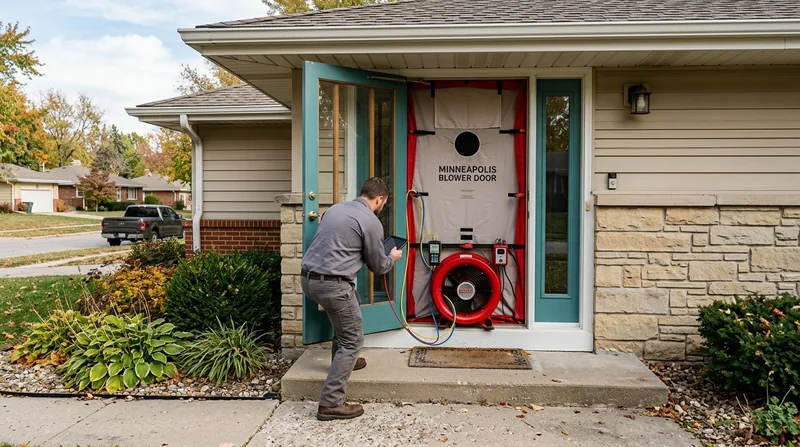




Air sealing in Omaha stops the hidden drafts that drive heating and cooling bills higher every season. Omaha's housing stock, from early 1900s balloon-framed bungalows in Dundee and Benson to mid-century ranches across the city and newer subdivisions in Millard and Elkhorn, sits over full basements where rim and band joists leak cold air all winter long. In climate zone 5A, with cold, windy winters off the Missouri River and hot, humid summers, air leaks around top plates, penetrations, and foundation edges cost money month after month. We find those gaps with precision, seal them with foam and sealant, and confirm the result with a blower door test so you know the work is done right.
Why Air Sealing Matters in Omaha Homes
Air leaks are invisible but their cost is real. In Omaha's continental climate, unconditioned air slips into living spaces through gaps at the rim joist, around electrical penetrations in the attic, along top plates where the wall meets the roof deck, and through poorly sealed ductwork chases. The rim and band joist alone, a common weakness in every full-basement home across Douglas and Sarpy counties, can account for 10 to 15 percent of a home's total heating loss. Blower door testing shows exactly where the air is moving, so we can prioritize the leaks that matter most and seal them to code.
- The rim joist and band joist perimeter is the single biggest air leak in most Omaha basements.
- Attic penetrations, including ductwork chases and electrical conduit, are the second major source of winter heat loss.
- Top plate gaps where the wall frame meets the roof deck allow conditioned air to escape into the attic in both heating and cooling seasons.
- A blower door test measures air tightness in CFM50 (cubic feet per minute at 50 pascals of pressure) and confirms that sealing work meets your target.
When air sealing is done correctly, the result is measurable and repeatable: less cycling of your furnace and air conditioner, steadier room temperatures, and lower utility bills month to month.
Key info: Omaha's building code (based on the International Energy Conservation Code) requires air sealing at the rim joist and attic boundaries. Your local building department sets the standard for blower door testing and CFM50 targets. We help you understand what applies at your address and help navigate permitting if it is required. See your city's building official for the rules that govern your property.
How We Seal Air Leaks: Our Process in Omaha
Air sealing starts with finding the leaks. We walk the attic, basement, and rim joist zone with a thermal camera and a blower door setup, marking every gap, crack, and penetration. Once we know where the air is moving, we seal strategically: spray foam closes large gaps and irregular cavities, polyurethane caulk and weatherstripping seal smaller cracks and door and window perimeters, and mastic tape seals ductwork seams and register boots. After sealing is complete, we run a post-sealing blower door test to confirm the improvement and show you the result in writing.
- We locate air leaks using a blower door and thermal imaging to identify the biggest sources of loss.
- We seal rim joists and band joists with closed-cell spray foam, which provides both air sealing and insulation in one step.
- We caulk top plates, electrical penetrations, and other small gaps with polyurethane sealant rated for the application.
- We seal ductwork seams and boot connections with mastic to stop air loss in the distribution system itself.
- We perform a post-sealing blower door test and deliver a written report showing the CFM50 improvement.
The whole process typically takes one to three days depending on home size and the extent of sealing needed. In a typical Omaha bungalow with a full basement and an unconditioned attic, we focus on the rim joist first, then the attic boundary, then any obvious ductwork or penetration issues.
Example: A 1,400-square-foot ranch in Ralston with cold floors and high winter bills turned out to have a wide open rim joist and several unsealed ductwork chases in the attic. After sealing the rim with closed-cell foam and the chases with caulk and mastic, the blower door test showed a 25 percent reduction in air leakage. The homeowner reported noticeably warmer floors by the following winter and a measurable drop in heating bills.
Air Sealing Methods and Approaches
| Method | Description | Best For |
|---|---|---|
| Closed-Cell Spray Foam | Rigid foam applied at 1.5 to 2 lb/ft3 density; provides both air seal and R-value (approximately 6.5 per inch). | Rim and band joists, large cavities, areas needing both seal and insulation in one application. |
| Polyurethane Caulk and Sealant | One-part or two-part polyurethane applied with a caulk gun; paintable and durable over time. | Top plates, small cracks, electrical penetrations, window and door frames. |
| Mastic Tape and Duct Sealant | Rubberized mastic applied by hand or brush to seal ductwork seams and register boot connections. | HVAC ductwork, supply and return plenums, boot-to-register connections in attics and basements. |
| Blower Door Testing | Pressurization test that measures whole-home air leakage in CFM50; identifies remaining gaps and confirms sealing success. | Pre-sealing diagnostic, post-sealing verification, code compliance documentation. |
The choice of method depends on the gap size, location, and whether insulation value is needed alongside the air seal. For more information on our closed-cell spray foam insulation services, which are often combined with air sealing work, visit our detailed service page.
Air Sealing Cost in Omaha: What to Expect
Air sealing pricing in Omaha depends on the home's size, the number and location of air leaks, and whether you include pre-sealing and post-sealing blower door testing. A straightforward rim joist sealing job on a typical Omaha ranch or bungalow starts at $650 and can range to $2,500 or more if the attic and multiple penetrations are included. Homes with older balloon-frame construction, wider rim cavities, or extensive ductwork in unconditioned spaces typically cost more because there is simply more linear footage and volume to seal. Blower door testing adds accuracy and proof of performance, and is strongly recommended.
The best way to understand your cost is to get a written estimate that includes the scope of sealing (which areas), the methods proposed (foam, caulk, mastic, testing), and the expected CFM50 improvement if testing is included. We provide written estimates with R-value and thickness specifications, and we do not charge a fee for the estimate or the blower door diagnostic that precedes it. For a full pricing overview and to request your free estimate, visit our pricing page or call us at (402) 807-2989.
What to Look for When Hiring an Air Sealing Contractor Near Omaha
Air sealing is a precision trade, and not all contractors approach it the same way. When you are evaluating contractors in Omaha, Bellevue, Papillion, La Vista, or anywhere across the metro, look for these markers of a professional operation. First, ask whether they use blower door testing to diagnose and verify the work. If a contractor offers an estimate without a pre-sealing blower door test, they are guessing at the problem. Second, verify that they are fully insured and ask for a certificate of insurance naming your address. Third, get at least two or three written estimates so you can compare scope, methods, and price. Fourth, check references from recent jobs in your neighborhood, and ask whether the contractor was reachable after the job was complete if questions came up.
Permitting for air sealing is not typically required in most Omaha jurisdictions, but some newer construction or energy-code-driven retrofits may require documentation. Always confirm with your local building department whether your project needs a permit, and choose a contractor who is willing to help you navigate that requirement. If your home is in an HOA-governed community, check whether exterior work (such as sealing around soffits or vents) requires architectural approval.
For a free, no-obligation estimate and to discuss your specific air sealing needs, contact us today. We will walk through the scope, explain the methods we recommend, and give you a price in writing before any work begins. Call (402) 807-2989 or request an estimate online, and we will respond within 24 hours.
Air Sealing in Omaha: Pricing Guide
| Service | Price | Details |
|---|---|---|
| Rim Joist Air Sealing | Starting at $650 | Closed-cell foam sealing of rim and band joist perimeter with pre- and post-blower door testing included |
| Attic Penetration and Top Plate Sealing | Starting at $450 | Caulk and foam sealing of electrical penetrations, ductwork chases, and top plate gaps in unconditioned attics |
| Whole-Home Air Sealing Package | Starting at $1,800 | Rim joist, attic boundaries, ductwork, and top plate sealing combined with pre- and post-blower door testing |
| Blower Door Testing Only | Starting at $300 | Diagnostic blower door test to measure air leakage and identify priority sealing targets for your home |
| Large or Complex Retrofit | On estimate | Multi-zone homes, extensive balloon framing, or commercial properties require on-site assessment before pricing |
| Free Estimate | No charge | Written estimate with scope, methods, and CFM50 targets delivered within 24 hours of initial call or online request |
Indicative pricing, the exact cost depends on square footage, finish, and site access. Free personalized estimate within 24h at (402) 807-2989.


