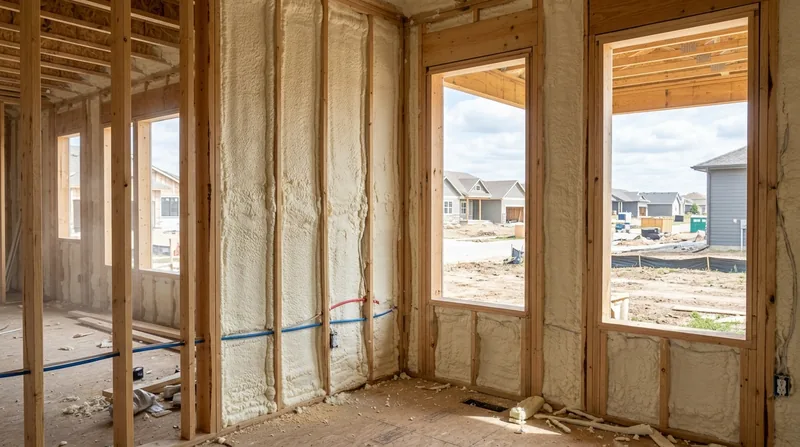




Commercial and new construction spray foam insulation in Omaha closes the thermal envelope before drywall and mechanical systems lock everything in place. New builds across Douglas and Sarpy counties face IECC climate zone 5A energy codes that demand continuous insulation and air sealing, and spray foam delivers both in a single pass. Whether you're framing an office shell in Millard, a warehouse addition in Bellevue, or a multi-unit residential project in Papillion, the window to insulate is narrow, the code is strict, and the performance penalty for getting it wrong is paid in heating and cooling bills for twenty years. We work directly with builders and general contractors to spray attics, walls, and crawl spaces before closing, meeting the energy standard that applies at your address and keeping your schedule on track.
Why Commercial and New Construction Spray Foam Matters in Omaha and Surrounding Counties
Omaha's building code requires continuous insulation and air sealing on new construction. The climate here punishes thermal gaps: cold, windy winters blowing off the Missouri River drive heating costs, and hot, humid summers reverse the vapor drive and push moisture inward through any crack or discontinuity. Spray foam closes both problems at once. Unlike fiberglass batts or blown-in cellulose, foam creates an air barrier and an insulation layer in one operation, eliminating the thermal bridging that plagues stud cavities and rim joists. For builders and GCs, that means one trade, one timeline, one invoice, and one warranty on the whole thermal envelope.
- We spray attics and sealed roof decks before sheathing and roofing go on, locking in the R-value your code requires without future settling or compression.
- We insulate walls and rim joists during framing, before drywall closes the cavity, so no demolition and no surprises after occupancy.
- We seal crawl spaces and band joists on foundation perimeters, where cold floors and winter drafts originate in nine out of ten Omaha homes.
- We work with your building schedule, staging the spray before the next trade arrives, and we pull no permits ourselves because permitting and contractor registration vary by city.
The result is a building envelope that meets code, stays tight for the life of the structure, and does not require re-entry or maintenance once cured.
Local example: A new office build in Ralston requires R-30 in the attic and continuous air sealing on all rim joists. Spray foam delivers both in one day, and the builder moves to the next phase without waiting for separate insulation and air sealing crews. The energy code is satisfied, the thermal bridging is gone, and the building is ready for HVAC rough-in.
For current code requirements and permit rules in your specific city, consult your local building department. Omaha, Bellevue, Papillion, and other jurisdictions in the metro may have different energy standards and contractor registration rules, so verify before you bid or schedule work. You can also review the ENERGY STAR new homes program for national baseline standards that many Omaha builders use as a reference.
How We Work with Builders and General Contractors in Omaha: The Spray Foam Process
We integrate into your framing and rough-in schedule. Once the frame is up and utilities are roughed, we arrive with our rig, spray the insulation to the thickness and R-value your code requires, and leave the space ready for drywall and mechanical. We use closed cell spray foam for walls and band joists where vapor control and structural strength matter, and open cell spray foam for attics and roof decks where cost and breathability are priorities. Each project gets a written estimate with R-value and thickness specs, so there is no guesswork on code compliance or performance.
- We schedule the spray date around your framing and mechanical timeline, usually two to three weeks after you call.
- Our crew arrives with equipment staged and sprays the insulation in one day, depending on the size and complexity of the structure.
- We maintain mechanical ventilation during cure and recommend a re-entry window of twenty-four to forty-eight hours before drywall or mechanical work resumes.
- We provide a written warranty on workmanship for one year from completion, and we stand behind the installation if any defect appears in that window.
For large commercial shells or multi-phase projects, we adjust our crew size and scheduling to match your timeline. Call us at (402) 807-2989 to discuss your build schedule and get a free commercial estimate.
Concrete example: A metal building warehouse in Gretna requires R-20 in the roof and continuous air sealing on all band joists. We spray 3 inches of closed cell foam in the walls, 5 inches in the roof deck, and seal the foundation rim in one mobilization. The builder frames the next day, the mechanical contractor rough-ins the week after, and the building is on schedule. The thermal envelope is locked, the building is tight, and the energy code is satisfied without delays or rework.
Learn more about our approach to air sealing and how it works alongside insulation in new construction.
Methods: Closed Cell, Open Cell, and Hybrid Approaches for New Construction
| Approach | Description | Best for |
|---|---|---|
| Closed Cell Spray Foam | Dense, rigid foam with R-value of 6 to 7 per inch. Acts as air barrier and vapor barrier. Resists moisture and provides structural support. | Walls, band joists, crawl spaces, metal buildings, and any application where vapor control and condensation prevention are critical in Omaha's humid summer climate. |
| Open Cell Spray Foam | Soft, lightweight foam with R-value of 3.5 to 4 per inch. Breathable, allows vapor transmission. Lower cost per board foot than closed cell. | Attics and roof decks where ventilation can manage moisture, and where cost per R-value is a priority. Not recommended for rim joists or crawl spaces in zone 5A. |
| Hybrid Approach | Closed cell on band joists and walls, open cell in attic. Combines vapor control where it matters with cost savings in large attic spaces. | Multi-story new construction and large commercial shells where budget and code compliance both matter. Common in new subdivisions across Millard and Elkhorn. |
| Injection Foam Retrofit | Closed cell foam injected into existing wall cavities through small holes. No demolition required. High R-value in tight spaces. | Existing walls in renovation projects and new additions to older stock. Used when new construction is built against pre-1980 balloon-frame walls in Dundee, Benson, or Midtown. |
Each approach is selected based on the building code that applies at your address, the climate zone, the end use of the space, and your budget. We write out the R-value and thickness for every section of the building so you know exactly what you are getting and why.
Commercial and New Construction Spray Foam Cost in Omaha: What to Expect
Spray foam pricing for new construction is driven by the R-value required by code, the square footage to be insulated, access and logistics, and the type of foam (closed cell is denser and more expensive than open cell). A typical new commercial shell in Omaha runs between $0.60 and $1.20 per board foot installed, depending on thickness, coverage area, and crew efficiency. A 5,000-square-foot attic at 5 inches of open cell foam (about 2,100 board feet) typically ranges from $1,200 to $2,500. A full rim and band joist seal on a 2,000-square-foot foundation perimeter in closed cell usually costs between $800 and $1,500. Large-scale commercial projects with complex geometry or multiple buildings may shift those numbers up, and tight access or demolition of failed insulation can add cost.
The best way to establish a realistic budget for your build is to call us for a free commercial estimate. We will walk your project, measure the square footage and required R-value, and give you a written quote with thickness and board foot count before you commit. We respond within 24 hours at (402) 807-2989.
Visit our pricing page for a detailed breakdown of cost factors and typical ranges across our service area.
What to Look for When Hiring a Spray Foam Contractor Near Omaha
Not every spray foam crew is the same, and the difference between a professional installation and a rig-and-run operation shows up in the long-term performance and safety of your building. Before you hire, verify that the contractor is fully insured, carries a certificate of insurance, and can produce it on request. Ask for references from builders or GCs they have worked with in the past twelve months, and call at least two. Check that they understand the energy code that applies at your specific address, because permitting and registration requirements vary by city across the Omaha metro, and there is no reciprocity between jurisdictions.
- Get a written estimate that specifies R-value and foam thickness for every section of the building, never a vague price per square foot.
- Verify that the contractor commits to mechanical ventilation during cure and a stated re-entry window of twenty-four to forty-eight hours before other trades arrive.
- Ask how they handle the substrate: wet attics, contaminated crawl spaces, or leaking foundations should be flagged and fixed before foam is sprayed, not sealed over.
- Confirm that the contractor carries workmanship warranty for at least one year, and understand what is covered and what is not.
If you are building in a master-planned community like those in Millard, Elkhorn, or Papillion, check your HOA architectural guidelines for any restrictions on exterior work or material choices. For new construction, the building department at your city will tell you what permits are required and what contractor registration is needed; we help you navigate what applies at your address, but permitting is always the builder's and the local authority's responsibility.
Ready to discuss your new construction or commercial build? Contact us for a free estimate and a conversation about your timeline and code requirements.
Commercial & New Construction Spray Foam in Omaha: Pricing Guide
| Service | Price | Details |
|---|---|---|
| Free commercial estimate | Free | Includes site walkthrough, R-value and thickness specs, written quote with board foot count, response within 24 hours |
| Open cell spray foam attic | Starting at $0.65/board foot | Typical 5,000 sq ft attic at 5 inches runs $1,200 to $2,500; cost varies by thickness required and roof geometry complexity |
| Closed cell spray foam walls and rim joists | Starting at $1.00/board foot | Denser foam for vapor control and structural strength; 2,000 sq ft foundation rim typically $800 to $1,500 depending on joist depth and access |
| Large commercial shell or multi-building project | On estimate | Complex geometry, multiple phases, or tight access requires site measurement and crew planning before pricing; call for scheduling |
| Travel | Included | No separate mileage fee in Omaha, Bellevue, Papillion, and surrounding Douglas and Sarpy County service areas |
| Workmanship warranty | One year | Covers installation defects and material integrity from completion date; manufacturer warranties on foam system available upon partner verification |
Indicative pricing, the exact cost depends on square footage, finish, and site access. Free personalized estimate within 24h at (402) 807-2989.


