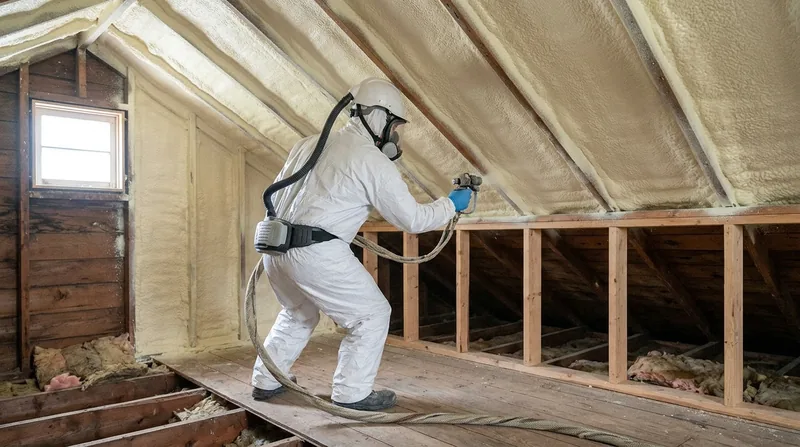




Insulation Replacement & Re-Insulation in Omaha is the fix for homes where old, flattened, or failed insulation leaves you burning money on heating and cooling. Dundee and Benson bungalows, mid-century ranches across the city, and newer subdivisions in Millard and Elkhorn all face the same problem: insulation that has settled, compressed, or degraded over decades loses its R-value and lets winter cold pour through attics and rim joists. Omaha sits in IECC climate zone 5A, where winters are cold and windy off the Missouri River and summers are hot and humid, so your heating and cooling loads are serious. When old fiberglass, cellulose, or mineral wool fails to perform, we remove it, air seal the gaps and penetrations, and install new spray foam sized for Nebraska's actual heating and cooling demands. The result is a tight, efficient attic or crawl space that holds temperature and cuts the drafts that drive your utility bills month after month.
Why Insulation Replacement Matters in Omaha's Climate and Housing Stock
Omaha's homes sit over full basements and under attics that experience extreme seasonal stress. Early 1900s balloon-frame houses in Benson and Midtown have rim and band joists along the foundation perimeter that are notorious cold-floor sources, while older attics packed with flattened fiberglass offer almost no resistance to winter heat loss or summer heat gain. The combination of cold, dry winters and humid summers reverses vapor drive by season, pushing moisture inward when the air conditioning runs and outward when the furnace heats. Insulation that was marginal when installed becomes a liability within ten to fifteen years, and once it settles or absorbs moisture, it cannot be restored by fluffing or topping up. A proper replacement removes the failed material, seals the air leaks that insulation alone cannot fix, and installs a system sized for the job.
- We pull out old, settled, or moisture-damaged insulation completely so we can see and seal every gap, crack, and penetration in the rim joist, top plate, and roof deck.
- We air seal with caulk and foam around electrical boxes, ductwork, plumbing, and wiring before installing new insulation so conditioned air stays inside.
- We install spray foam in the R-value and thickness your home actually needs for zone 5A heating and cooling, not a generic one-size-fits-all approach.
- We manage moisture properly because Omaha's humidity and winter cold mean vapor control is as important as insulation thickness.
Replacing failed insulation with a properly sealed and sized system is the single most effective way to stop drafts, balance room temperatures, and lower your heating and cooling costs.
Key info: A home in Papillion or La Vista with flattened attic insulation and a basement rim joist that feels cold in winter is losing conditioned air through multiple leaks. Replacement addresses both the insulation failure and the air sealing that fiberglass never managed, which is why the result feels so different.
How Insulation Replacement & Re-Insulation Works: Our Process in Omaha
Insulation replacement is a measured, methodical process that begins with understanding what you have, why it failed, and what will work in its place. We start with an on-site look at the existing insulation, the condition of the substrate (roof deck, rim joist, or wall cavity), and any moisture, contamination, or structural issues that must be addressed first. Once we understand the scope, we remove the old material, seal air leaks with caulk and foam, and install new spray foam to the R-value and thickness specified for your location and use. The entire job is planned to manage temperature and humidity during the work, and we provide a clear re-entry window so you know when the space is safe to occupy. For details on how this applies to attics specifically, see our attic spray foam insulation page.
- We inspect the attic, crawl space, or wall cavity to identify failed insulation, air leaks, moisture, and any substrate damage that must be fixed first.
- We remove all old insulation, debris, and contaminated material so we can see every crack, gap, and penetration that needs sealing.
- We air seal with caulk and closed-cell foam around electrical, plumbing, and HVAC penetrations, rim joists, and top plates before spraying new insulation.
- We install spray foam in the thickness and R-value specified for your climate zone, measured on site at the board foot to ensure accuracy.
- We provide mechanical ventilation during the cure phase and a clear timeline for re-entry so you understand the process and the safety window.
The result is a sealed, insulated envelope that performs consistently and does not settle, compress, or lose R-value over time the way fiberglass does.
Real example: A 1960s ranch in Ralston with an attic full of flattened fiberglass and rim joists that feel cold in winter receives a complete removal, air sealing, and spray foam replacement. The homeowner sees no cold spots on the rim joist, consistent attic temperature, and a quieter home because the foam also dampens sound transmission.
Insulation Replacement Methods and Approaches
| Approach | Description | Best for |
|---|---|---|
| Closed-Cell Spray Foam Replacement | High-density foam applied to the existing substrate after removal and air sealing. Provides 6+ R-value per inch, acts as an air barrier, and resists moisture. Requires proper ventilation during cure and a thermal barrier in attics. | Attics in older homes, rim joists, crawl spaces, and any area where moisture control and high R-value per inch are critical in zone 5A. |
| Open-Cell Spray Foam Replacement | Lower-density foam applied after removal and air sealing. Provides 3.5 to 4 R-value per inch, is breathable, and offers sound dampening. Lower cost per square foot and easier to install in standard wall cavities and attic knee walls. | Attics where moisture management is secondary to cost and sound control, and walls where vapor permeability is desired. |
| Blown-In Replacement (Cellulose or Mineral Wool) | Loose-fill insulation installed after removal and air sealing. Settles over time and offers 3 to 4 R-value per inch depending on material. No air sealing benefit on its own, so air sealing must be done separately with caulk and foam. | Top-up of existing attics where the substrate is sound and air sealing is already complete, or where budget is the primary constraint. |
| Injection Foam in Existing Walls | Low-pressure foam injected into closed wall cavities of older homes without interior demolition. Fills voids and improves R-value in pre-1980 balloon-frame and brick-veneer construction. Requires careful substrate inspection and drilling access holes. | Exterior walls of Dundee and Benson bungalows and older ranches where adding interior insulation is not feasible and exterior work is not planned. |
Insulation Replacement & Re-Insulation Cost in Omaha: What to Expect
Insulation replacement costs depend on the size of the space, the type and R-value of the new insulation, how much old material must be removed, and the complexity of air sealing. A typical attic replacement in an Omaha home starts at around $2,800 and rises based on square footage, substrate condition, and the R-value required. Crawl space and rim joist work follows a similar pattern, with costs driven by the linear feet of rim joist and the depth of the crawl space. Wall injection in older homes costs less per square foot because no removal is needed, but the number of wall cavities and the building's layout affect the total. Getting written estimates with R-value, thickness, and board-foot specifications from two or three contractors is the only way to compare apples to apples and understand what drives the price in your home. Visit our pricing overview for more detail on what moves the needle.
- Attic replacement in a 1,500-square-foot home with complete removal and spray foam to R-38 or R-49 typically ranges from $2,800 to $5,500 depending on access and substrate repair.
- Rim joist and band joist sealing in a full basement runs from $1,200 to $2,400 per perimeter, determined by the linear feet of joist and the depth of the rim.
- Crawl space replacement with removal, air sealing, and closed-cell foam starts at $3,200 and increases with square footage and moisture control complexity.
- Wall injection in older homes costs $1.50 to $3.00 per board foot, with total costs depending on the number of cavities and wall area to be filled.
- All estimates include travel within Omaha and surrounding areas, and we provide a free, no-obligation written estimate with R-value and thickness specifications within 24 hours.
The most important step is getting a clear, detailed estimate that explains what is included and why the price is what it is, so you can make an informed decision and avoid low-ball quotes that hide poor workmanship or incomplete scope.
What to Look for When Hiring an Insulation Replacement Contractor Near Omaha
Hiring the right contractor for insulation replacement is about checking credentials, understanding the scope, and verifying that the work meets your local building code. Start by confirming that any contractor you call carries full insurance and can provide a certificate of insurance on request. Ask for written estimates that include the R-value, thickness in inches, and the total board feet of foam or blown-in material, so you can compare one estimate to another and verify that the product matches your climate zone needs. Check references from recent jobs in Omaha, Bellevue, Papillion, or La Vista, and ask specifically about air sealing, cure time, and whether the work addressed the homeowner's original complaint. Understand your local permit requirements by calling your city building department before hiring, because thermal barrier and ventilation rules vary across Douglas, Sarpy, and surrounding counties. If your home is in a master-planned community, verify HOA architectural rules with the board to confirm that any exterior work (such as crawl space access or venting modifications) is approved. Contact us at (402) 807-2989 for a free estimate and we will walk you through what applies at your address and what the job will include.
- Verify that the contractor is fully insured with a current certificate of insurance, and ask to see proof of coverage before work begins.
- Request written estimates with R-value, thickness, and board-foot specifications so you can compare quotes and confirm the product meets your climate zone.
- Check references from recent jobs in your neighborhood and ask about the contractor's responsiveness after the work is complete.
- Confirm permit requirements with your city building department before hiring, because thermal barrier and ventilation rules vary across the metro.
- Ask about the contractor's process for managing moisture and ventilation during cure, and what the re-entry window is so you know when the space is safe to use.
- Get a clear timeline for the work, including removal, air sealing, foam installation, and cure time, so you can plan around the project.
A contractor who takes time to explain the work, provides detailed estimates, and answers your questions directly is the one most likely to deliver a job that performs as promised and stands up to Omaha's climate demands.
Insulation Replacement & Re-Insulation in Omaha: Pricing Guide
| Service | Price | Details |
|---|---|---|
| Attic Replacement (Removal & Spray Foam) | Starting at $2,800 | Includes removal of old insulation, air sealing, and spray foam to R-38 or R-49 for zone 5A. Cost rises with square footage and substrate repair needs. |
| Rim Joist & Band Joist Sealing | Starting at $1,200 | Includes air sealing and closed-cell foam per linear foot of basement perimeter. Priced by the joist length and depth of the rim cavity. |
| Crawl Space Replacement (Removal & Spray Foam) | Starting at $3,200 | Includes removal of old insulation, air sealing, and closed-cell foam for moisture control. Cost determined by square footage and substrate condition. |
| Wall Injection Foam (Retrofit, No Demolition) | Starting at $1.50 per board foot | Includes drilling access holes and injecting low-pressure foam into closed cavities. Total cost depends on wall area and number of cavities to fill. |
| Complex or Large-Scale Replacement | On estimate | Multi-zone jobs, substrate repair, moisture remediation, or commercial spaces require on-site inspection before a firm price is quoted. |
| Free Estimate & Travel | No charge | Written estimate with R-value and thickness specs within 24 hours. Travel included in Omaha and surrounding areas, no separate mileage fee. |
Indicative pricing, the exact cost depends on square footage, finish, and site access. Free personalized estimate within 24h at (402) 807-2989.


