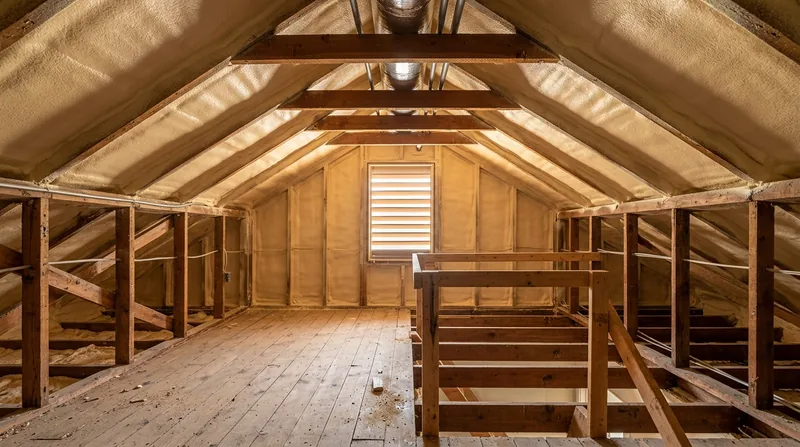




Attic spray foam insulation in Omaha stops the heat loss that drives winter bills through Zone 5A cold and summer cooling costs through the humid season. Omaha attics run hot in summer and leak heat fast in winter, and the combination of gapped roof decks with the seasonal swing off the Missouri River makes the attic the single biggest energy leak in most homes across Dundee, Benson, Midtown and the newer subdivisions toward Millard and Elkhorn. We spray closed cell or open cell foam directly to the roof deck to seal air leaks, raise R-value, and flatten the temperature swings that make your HVAC system work overtime. The result is quieter cooling in July, warmer floors in January, and a measurable cut in what you pay to condition the space. Since 2009, we have sprayed attics across Douglas, Sarpy and the surrounding counties, and we work with the local building codes that apply at your address. Start with a free estimate at (402) 807-2989.
Why Attic Spray Foam Insulation Matters in Omaha
Omaha's housing stock sits across a wide range of ages and conditions. Early 1900s bungalows in Dundee and Benson often have balloon-framed walls and attics where insulation has settled and compressed over decades. Mid-century ranches across the metro have standard attic frames but shallow or uneven insulation. Newer two-story homes pushing toward Papillion and Gretna have bonus rooms over attached garages, and those second-floor spaces sit directly under an attic that leaks heat and lets summer heat in. The climate here is IECC Zone 5A, cold and windy in winter off the Missouri River, hot and humid in summer. That seasonal swing means your attic is the path of least resistance for both heating loss and cooling load, and most homes lose more money through the attic than through any other single building boundary.
- Attic air leaks around rafters, collar ties, soffit vents and penetrations draw cold winter air into living spaces and let conditioned summer air escape into the unconditioned attic.
- Fiberglass batts and blown-in insulation settle, compress and leave gaps that widen over time, especially in Midtown and Benson homes where the attic has seen fifty or more years of seasonal movement.
- Sealed attic decks (also called unvented attics) spray-foamed directly to the underside of the roof deck stop air leaks and raise R-value without relying on soffit ventilation to work correctly.
- Closed cell foam delivers higher R-value per inch in tight spaces, which matters when headroom is limited or when condensation control on the roof deck is the primary goal.
- Open cell foam costs less, delivers reasonable R-value for most attics, and allows the attic to breathe if ventilation is present, making it the right choice for many retrofit jobs where the existing roof vents are open.
Stopping attic air leaks and raising insulation R-value are the two fastest ways to lower heating and cooling bills in an Omaha home.
Key info: Attic ventilation, ignition barriers, and thermal barriers are governed by the energy and building code in force at your address. The building official in Omaha, Bellevue, Papillion, La Vista or Ralston has the final say on whether your attic must be vented and whether a thermal barrier is required between the foam and the living space below. We help you understand what applies, and we build to code.
How We Spray Attic Foam in Omaha: The Process
Attic spray foam work starts with a walk-through to measure the attic deck, check for moisture, roof leaks, or existing contamination, and understand the ventilation and code requirements at your address. We scope the job, estimate the board feet needed, and give you a written estimate with R-value and thickness specs so you know exactly what you are paying for and what the finished job will deliver. Once you book, we schedule at a time that works for you, set up mechanical ventilation to manage cure fumes, spray the foam in controlled passes to the specified thickness, and let it cure fully before you re-enter the space. The whole process typically takes one to three days depending on attic size and complexity.
- We inspect the attic for roof leaks, moisture, or existing insulation that needs removal before we spray, and we walk the building code requirements at your address with you.
- We measure the attic deck, calculate board feet, and provide a written estimate with R-value, thickness, and price per square foot so there is no guessing.
- We set up mechanical ventilation (fans and ducting) to exhaust cure fumes to the outside during application and curing, ensuring safe air quality inside the home.
- We spray the foam in thin, controlled passes to build up to the specified thickness, holding the correct spray ratio and drum temperature throughout the job.
- We allow the foam to cure fully (typically 24 to 48 hours) before you use the attic space or return to normal HVAC operation.
- We perform a final walkthrough, answer questions, and provide care instructions for the cured foam.
A typical attic spray foam job in an Omaha home takes two to three days from setup to full cure.
Local example: A 1,200 square foot attic in a Benson bungalow with old fiberglass batts and visible air leaks around the collar ties and soffit vents gets a two-inch closed cell spray foam application to the roof deck. We remove the old batts first, spray the foam in two passes, set up fans to cure overnight, and the homeowner re-enters the next day. The attic is now sealed and insulated to R-13 per inch of foam, with no air leaks and no settling. Learn more about insulation removal if your attic has existing material that needs to come out first.
| Approach | Description | Best for |
|---|---|---|
| Closed Cell Spray Foam | High-density foam (1.5 to 2.0 pcf) with R-value of 6.0 to 6.5 per inch. Blocks air and vapor, provides structural rigidity, and controls moisture on the roof deck. | Sealed attics where condensation control is critical, tight spaces where R-value per inch matters, and roofs that see high moisture risk from summer humidity. |
| Open Cell Spray Foam | Lower-density foam (0.5 to 1.5 pcf) with R-value of 3.5 to 3.7 per inch. Allows vapor to move through the material, costs less per board foot, and works well in ventilated attics. | Standard attics with existing soffit vents open, retrofit jobs where cost is a primary concern, and homes where the attic will remain ventilated. |
| Foam Over Existing Insulation | Open cell foam sprayed over sound fiberglass batts or blown-in insulation to seal air leaks without tearing out the old material. Works only if the existing insulation is dry and free of mold or contamination. | Budget-conscious retrofits where existing insulation is still performing and the main goal is to stop air leaks and add a layer of R-value. |
| Full Attic Removal and Replacement | Complete removal of old insulation, air sealing of all penetrations and leaks, and spray foam application to the roof deck or attic floor. Ensures a clean slate and maximum energy performance. | Attics with settled, compressed or contaminated insulation, homes where energy performance is the top priority, and jobs where the existing insulation is blocking access to air leaks. |
Attic Spray Foam Insulation Cost in Omaha: What to Expect
Attic spray foam insulation in Omaha typically starts at $1.50 per square foot for open cell applications on straightforward attic decks with good access and no existing insulation removal needed. Closed cell foam, which delivers higher R-value per inch and stronger moisture control, runs higher, typically $2.50 to $4.00 per square foot depending on thickness and the complexity of the roof structure. The total cost of your job depends on several concrete factors: the square footage of the attic deck, whether you need old insulation removed first, the thickness and R-value target you choose, and whether the attic has obstacles like HVAC ducts, electrical work or roof penetrations that slow down the spray process.
A typical 1,200 square foot attic in Omaha with a two-inch open cell application and no removal needed runs $1,800 to $2,400. The same attic with a two-inch closed cell spray and removal of old batts runs $3,600 to $5,200. Jobs that require a thermal barrier (a non-foam layer between the foam and the living space below to meet code) or that involve complex roof geometry, multiple valleys or tight access add time and material, which moves the cost up. Getting a detailed estimate with R-value and thickness specs from two or three contractors is the only reliable way to compare prices, because spray foam is measured on site at the board foot and quoted after inspection.
Travel to your home in Omaha, Bellevue, Papillion, La Vista, Ralston, Gretna or the surrounding areas is included in our price, with no separate mileage or call-out fee. A free estimate is yours within 24 hours of calling (402) 807-2989.
Attic Spray Foam Insulation Near Me: What to Look for When Hiring a Contractor in Omaha
Hiring the right spray foam contractor in Omaha, Bellevue or any of the surrounding areas is a decision that affects the comfort and energy performance of your home for years to come. The spray foam trade has both rig-and-run crews from out of state (a job sprayed in an afternoon, nobody reachable when the smell won't go away or the foam fails to cure) and national franchises with high overhead and limited local knowledge. The local independent contractor with an Omaha address and local plates is positioned to give you honest guidance, verify credentials, and stand behind the work. Here is what to verify when you call any spray foam insulator, including us.
- Confirm that the contractor is fully insured with current coverage for the scope of work you need, and ask for a certificate of insurance that names you as an additional insured.
- Get written estimates from at least two contractors that include R-value per inch, foam thickness in inches, total board feet, and price per square foot so you can compare apples to apples.
- Ask about the spray ratio, drum temperature, and mechanical ventilation setup during cure, and understand the re-entry window (typically 24 to 48 hours) before the attic is safe to use.
- Check whether permits are required at your address (Omaha, Bellevue, Papillion and other cities have different rules) and confirm that the contractor will help you navigate what applies locally.
- Verify that the contractor understands the thermal barrier and ventilation rules that apply in your city and will build to code without shortcuts.
- Ask for references from recent jobs in Omaha or the surrounding area, and call at least two to ask about the quality of the work, the professionalism of the crew, and whether the contractor was reachable after the job was done.
A contractor who gives you a price with no R-value and no thickness, promises immediate re-entry, or quotes a price far below market is a signal to walk away and call someone else. Contact us at our contact page or call (402) 807-2989 to schedule your free estimate and ask any questions about how we work.
Attic Spray Foam Insulation in Omaha: Pricing Guide
| Service | Price | Details |
|---|---|---|
| Open Cell Spray Foam Attic | Starting at $1.50/sq ft | Two-inch application on attic deck with good access, no removal needed, standard roof geometry |
| Closed Cell Spray Foam Attic | Starting at $2.50/sq ft | Two-inch application for sealed attics, higher R-value per inch, moisture control on roof deck |
| Insulation Removal and Replacement | On estimate | Removal of old batts or blown-in, disposal, and new foam spray; price depends on volume and contamination |
| Complex or Multi-Section Attics | On estimate | Multiple roof angles, tight access, HVAC ducts, or electrical obstacles that slow spray rate require on-site measurement |
| Travel | Included | No separate mileage or call-out fee in Omaha and surrounding areas within service radius |
| Free Estimate | No obligation | Written estimate with R-value, thickness, and price within 24 hours of your call to (402) 807-2989 |
Indicative pricing, the exact cost depends on square footage, finish, and site access. Free personalized estimate within 24h at (402) 807-2989.


